Week of April 26 - May 2, 2026
Fresh from its historic visit by four intrepid astronauts from Earth, the moon will shine brilliantly in our evening sky this week. It will reach its full phase on the evening of April 30, when it rises in the east just at sunset, and I hope you'll step outside to enjoy it. Being near its "apogee" (farthest point from the Earth), experienced lunar gazers may notice it appears a bit smaller than usual.
Those wanting to see stars this week, however, may be a bit disappointed. With our brilliant moon overpowering the sky this week, stars will be in short supply. But bright moonlight isn't the only reason. The fact is that our springtime sky is noticeably devoid of bright stars. Compared to the brilliant stars of winter that we've enjoyed the past few months, it appears quite anemic.
From our vantage point on Earth, it's really quite simple why the night sky changes as it does from season to season. As our planet orbits the sun, we look outward in different directions after sunset, and we see different stars and star groupings, depending on where we are in our orbit. Now this change is extremely gradual (only about one degree of shift every night), but over the past few months, our view outward has shifted considerably.
Traditionally, stargazers consider the wintertime sky to feature such bright star groupings as Orion the hunter, Canis Major the great hunting dog, Taurus the bull, and Lepus the hare. And sure enough, these constellations have graced our night sky since they first appeared in the eastern sky after dark late last autumn.
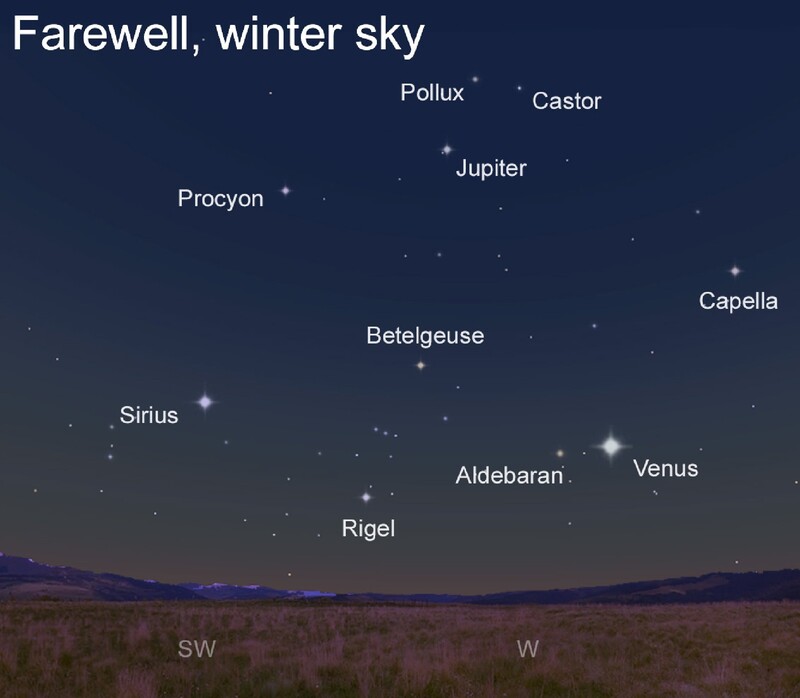
No longer rising in the east at dusk, these beautiful and brilliant wintertime celestial showpieces are now descending in the west as evening falls. And soon, they'll be gone from view altogether.
Also appearing in the western sky right now are two planets: Jupiter and Venus. They will remain there through much of the springtime, though by early June their own orbital motions will make them appear to converge on each other over the western horizon. By July, Jupiter will be gone, but Venus will hang on through most of the summer.
But fear not. They're not gone forever. True, they'll be blotted out by the sun's glare for a few months, passing overhead not during our dark nighttime hours but during the daytime this coming summer.
Eventually, however, these planets and the winter stars will reemerge on "the other side" of the sun and will shine beautifully in the eastern sky at dawn. This won't happen until later this summer, but I can assure you that I'll be out watching when they return to our view.
Right now, however, we must be content to watch as the winter celestial gems descend in the western sky at dusk. One of the most startling sights will occur as the brilliant star Sirius (in Canis Major) descends lower and lower. Since light of various colors twinkles differently, this bright star will appear to radiate like a Fourth of July sparkler before disappearing behind the western horizon.
Not a bad farewell to some of our celestial friends of winter!
Visit Dennis Mammana at dennismammana.com. To read features by other Creators Syndicate writers and cartoonists, visit the Creators Syndicate website at www.creators.com.
Several star groupings and planets are still visible to stargazers during the springtime.







View Comments