Week of April 19-25, 2026
During my long career working in planetariums, I had a great advantage. Not only could I move the sun, moon and planets around the sky, I could also make the stars appear in the daytime and even make clouds disappear at will. In other words, I had control of the entire universe. Now that was a great gig!
I could do this in a planetarium because everything we saw was projected onto a thin aluminum dome overhead and operated by an electronic control panel. Some in the ancient world believed that the real sky was similar to a planetarium dome, with a series of crystalline spheres that carried everything in the heavens around us. This is certainly understandable; stand under a daytime or nighttime sky and it's tough to believe otherwise.
Fortunately, modern science has given us many sophisticated techniques to measure distances to celestial objects, and we now know that this crystalline dome idea is merely an illusion caused by our eyes' inability to perceive depth at great distances.
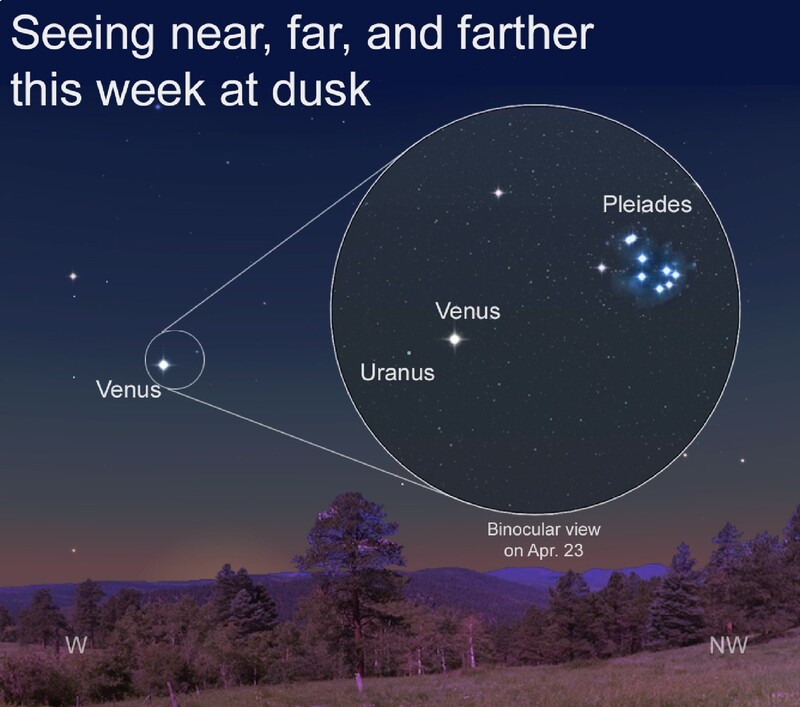
This week, we'll have an opportunity to aim binoculars toward the sky and see three celestial targets, each at a much greater distance than the other. The best evening to view them is Thursday, April 23.
The first of these is the planet Venus. Now appearing as a brilliant "star" in the western sky at dusk, Venus is currently the closest planet to us. It shines so brightly because it's a world the size of Earth and is covered with sunlight-reflecting clouds. On the 23rd, it will be the nearest natural object in our sky, at a distance of "only" 136.8 million miles from us.
It's still pretty distant, so if you aim binoculars toward this planet, you won't see much except a brighter dot of light. But if you do so as the sky begins to darken, you may see two other objects.
To the lower left of Venus will appear the planet Uranus. This world is the first to be discovered by telescope (in 1781 by musical composer and amateur astronomer William Herschel). Unfortunately, it's really faint because it's so distant — some 1.9 billion miles away.
The third object is a star cluster known as the Pleiades, or Seven Sisters. Normally, it shines nicely very high in the winter sky, but now that spring is upon us, it's descending farther to the west each evening. This grouping of relatively young stars lies at a distance of 2,600 trillion miles.
Since the sky won't be completely dark at dusk, and these three will lie quite low against the horizon, it'll be tough to see all of them in the same binocular field of view. It's certainly worth trying, though.
On the 23rd, the light reflected from the cloudtops of Venus will have taken only 12.3 minutes to reach us (we say it's 12.3 light-minutes away), and that from Uranus will have traveled some 2.8 hours.
The starlight from the Pleiades, on the other hand, has spent some 444 years traveling in our direction; in other words, it began its journey around 1582 and is just arriving tonight!
So much for crystalline spheres!
Visit Dennis Mammana at dennismammana.com. To read features by other Creators Syndicate writers and cartoonists, visit the Creators Syndicate website at www.creators.com.
April 23 will be a great evening to view Venus, along with Uranus and the star cluster Pleiades.







View Comments