Week of January 25-31, 2026
Few things are as captivating as a dark, star-filled sky. But the stars we see and enjoy don't just "exist"; they all came into being long ago inside of massive clouds of gas and dust known as "nebulae."
Within these clouds, clumps of interstellar material eventually begin to collapse under their own weight; when one becomes dense and hot enough, thermonuclear fusion begins at its core, and a star is born. Leftover material is accreted into smaller bodies orbiting nearby: a planetary system.
We can find such stellar birthplaces scattered all around the heavens, and many are visible to anyone with just binoculars or a small telescope. The most amazing, however, is visible even to the unaided eye right now: the Great Orion Nebula. As its name suggests, it's located in the brilliant constellation Orion, the hunter, now appearing in the southeastern sky after dark.
This ancient constellation was known to the Sumerians of Mesopotamia as far back as the 4th millennium B.C. Later, the Egyptians saw Orion as the god Osiris, and the early Greeks knew him as the son of the sea god Poseidon and a powerful hunter.
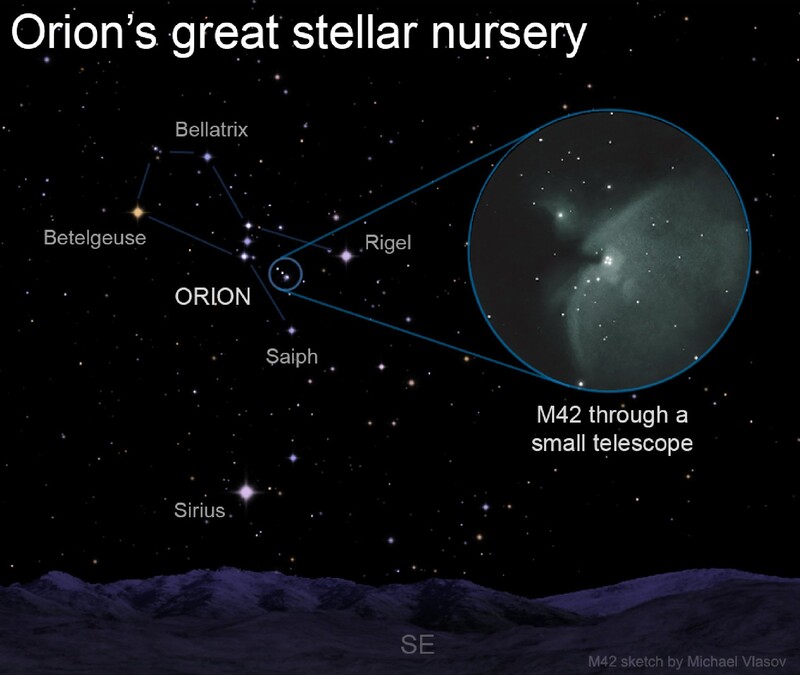
Two bright stars, Betelgeuse and Bellatrix, mark the hunter's shoulders. Saiph and Rigel form his knees. In his midsection lie three stars in a nearly straight line that trace his belt. And below hangs his sword that appears as a smudge of light. This is the Great Orion Nebula, also known to astronomers as M42.
M42 is a colossal cloud of interstellar gas and dust that lies some 9,000 trillion miles, or about 1,300 lightyears, away, and is one of the largest, brightest and most beautiful of all "deep sky" objects.
It is also one of the most prolific star-forming clouds in our part of the Milky Way Galaxy, where new stars and planetary systems are continually being born. Binoculars show it as a hazy smudge surrounding some bright stars, but aim a small telescope in its direction, and you will experience one of the most marvelous sights in all the heavens.
Here you'll see the wispy structure of this stellar nursery, and near its center you'll easily spot a tightly packed grouping of four young stars (the "Trapezium") that illuminate the cloud from within. Astronomers estimate these stars to be only about 300,000 years old; sounds pretty ancient — and it is when we think in human time scales — but these are mere stellar toddlers, equivalent to only about two or three years old in human terms.
It is from a similar nebula somewhere in our galaxy that our own star and planetary system came into being some 4.6 billion years ago. Exactly where that was, we cannot say, of course, but we know that our sun and the planets of our solar system formed within such a cloud. Perhaps even more remarkable is that, from such an origin, our species has evolved the curiosity, intelligence and technology to learn this very fact!
If bright moonlight makes it tough for you to spot the nebula this week, don't worry. You've got plenty of time. Orion and M42 will grace our evening skies all winter long!
Visit Dennis Mammana at dennismammana.com. To read features by other Creators Syndicate writers and cartoonists, visit the Creators Syndicate website at www.creators.com.
The Great Orion Nebula is visible with the unaided eye.






View Comments