Now that every "car" company sells mostly crossovers, how do you get the crossover you're hoping to sell to stand out from the crowd? One of the ways Infiniti has come up with is to offer a crossover that has an engine that's different than the engine you'll find in any other crossover.
What It is
The QX60 is a midsize, three-row luxury crossover that's related to the Nissan Pathfinder. It features a variable compression, or VC, engine as well as features and amenities that are not available in the Pathfinder, such as a 20-speaker Klipsch premium audio system, quilted leather dashpad/trim and ProPilot Assist, which bundles adaptive cruise control and a Blind Spot Intervention system that steers the vehicle back into its travel lane if you try to change lanes while there's another vehicle in your blind spot.
Another big difference is the price.
The QX60 starts at $51,590 for the pure trim, with front-wheel drive ($53,600 with the optional all-wheel-drive system) versus $37,500 for the base Pathfinder, which also comes standard with a V6 that's more powerful than the QX60's 2.0-liter VC four. But the QX — being an Infiniti rather than a Nissan — does come standard with three-zone climate control, 20-inch wheels, a panorama sunroof, a digital main gauge cluster (and 12.3-inch secondary touch screen) as well as a heated steering wheel, power rear liftgate and wireless phone charge pad.
The $56,900 QX60 Lux ($59,000 with AWD) gets roof rails, heated second-row seats, ventilated front seats and a 16-speaker Klipsch audio system.
The $62,190 Sport trim comes with AWD standard as well as second-row captain's chairs and a removable second-row center console, plus special five-spoke, 20-inch wheels and dark chrome exterior trim.
A top-of-the-line Autograph QX60 also comes with AWD and upgrades to a 20-speaker Klipsch audio system, plus adaptive headlights that turn in the curves, a heads-up display, the quilted leather trim/upholstery upgrades, massaging front seats, a household 115V power outlet and a towing package that includes a transmission oil cooler and trailer sway assist.
Properly equipped, the QX60 can tow up to 6,000 pounds — about 1,000 pounds more than most same-sized crossovers are rated to pull.
What's New for 2026
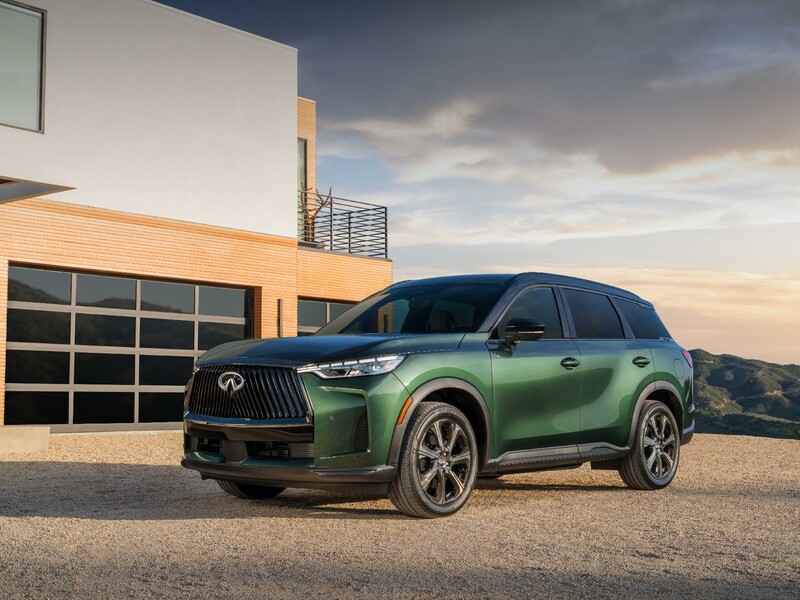
In addition to a revised front clip with a new-design grill (with an illuminated "Infiniti" badge) all trims now come standard with 20-inch wheels and the Autograph trim gets a new puddle lamp system that comes on automatically as you approach the vehicle, projecting "Infiniti" on the ground on both sides of the vehicle.
What's Good
— Handsome outside and plush inside; a cut above its merely Nissan-badged sibling, the Pathfinder.
— VC engine develops a pleasant swell of low- and mid-range torque, making the QX60 feel responsive without having to floor the accelerator pedal.
— Can tow almost as much as some truck-based SUVs.
What's Not So Good
— About $14,000 more expensive to start than the closely related Pathfinder — which comes standard with a V6.
— VC four sounds tinny when pressed.
— Pure and Lux trims are not available with captain's chairs.
Under the Hood
Usually, when you have a luxury and a mass-market version of the same basic vehicle, it's the luxury-badged version that gets the bigger/stronger engine. For example, the Cadillac Escalade comes standard with a 6.2-liter, 420-horsepower V8 while the closely related but merely Chevrolet Tahoe comes standard with a smaller, not-as-powerful 5.3-liter V8.
The QX60 comes standard with a 2.0-liter four that touts 268 horsepower while the closely related Nissan Pathfinder still comes standard with a 284-horsepower 3.5-liter V6. This engine used to be standard in the QX60 too. It was replaced last year by the new VC four, which has a crankshaft/connecting rod system that allows the compression ratio to be adjusted continuously, in accordance with the driver's expressed demand for more power. More pressure on the accelerator pedal increases the engine's compression ratio (by increasing or decreasing the stroke of each of the four pistons as they travel up and down within the cylinders) and the power/responsiveness of the engine. When the pressure is eased, cylinder compression is reduced. The system works in conjunction with a turbo, with the idea being to provide on-demand power, sharper throttle response and maximum efficiency. The system is capable of varying compression from as low as 8:1 to as high as 14:1.
In theory, this ought to dramatically increase gas mileage, but in this case, there's very little actual difference between the Infiniti's 22 mpg city/28 mpg highway and the V6-powered Pathfinder's 21 mpg city, 27 mpg highway. This isn't so much the fault of the VC engine as it is a consequence of the weight of the QX60 — which is a beefy 4,671 pounds. That's a lot for any engine to lug around but especially a small four-cylinder engine. Because the QX60 is so heavy, the little engine is running at high CR (and boost) most of the time it's moving. The Pathfinder's V6 doesn't need to work as hard to move the same weight, which is why — paradoxically as it may seem — the much larger engine hardly uses more gas than the much smaller engine.
Both engines are paired with a nine-speed automatic and either FWD or AWD, depending on the trim and whether you elect to buy the AWD system.
On the Road
The QX60 has a noticeably different driving demeanor relative to the Pathfinder. This has its good and its bad points.
On the good side of the ledger, the VC four feels stronger than the old V6. It takes less downward pressure on the accelerator pedal to elicit a lively response from the engine; sometimes, you'll skitter the front tires (FWD models) if you push down a bit too hard. This imparts some real driving fun, if you're into that kind of fun — and if you're not, the important thing is that the VC engine responds authoritatively, which is a quality that people spending $50,000-plus on a luxury-badged vehicle expect to get for their money.
On the bad side of the ledger, the VC engine sounds tinny when pressed. This is, arguably, the big problem with these small engines that have become increasingly common in large (and heavy) luxury vehicles such as the QX60. They are not size (and weight) appropriate.
Or price-appropriate, for that matter.
Other than that, the QX60 delivers the overall experience it ought to. It is noticeably quieter (excepting the tinniness of the engine at full throttle) than its Pathfinder sibling and more comfortable too. The seats are wonderful; you can feel your buns even after three hours of straight driving — and the available 20-speaker Klipsch audio system is exceptional as well as unusual in that a majority of luxury vehicles use Bose as their audio system provider; Bose makes good stereos too. But the Klipsch system is really good. So also the available massage feature for the front seats.
At the Curb
If you didn't know it, you might not be able to tell the QX60 and the Pathfinder are closely related. The latter has been styled to look like a four-wheel-drive SUV it isn't, while the QX60 looks like the luxury crossover it is.
It's handsome — not obstreperous. Inside, it's sumptuous — especially the top-of-the-line Autograph trim.
Both of these midsize fraternal twins are about the same size — the Infiniti is 198.1 inches long overall while the Nissan is 197.7 inches long — and both have comparable room inside for people and cargo, though the Nissan has a bit more of the latter: 16.6 cubic feet behind its third row and 80.5 cubic feet with the third and second row folded versus 14.5 cubic feet behind the Q's third row and 75.4 cubic feet all told. The reason why is the Infiniti's second row has more legroom — 37.7 inches versus 35.5 inches in the Pathfinder. This makes perfect sense given the QX60 is designed to be primarily a luxurious passenger-carrying vehicle, while the Pathfinder is meant to be a more practical, family-oriented vehicle.
The QX60 has an interestingly different control pad for the seat heaters (and coolers) as well as the HVAC system's fan speed. It looks like a flat sheet of tap/swipe LCD, but it's pressure-sensitive, so you can feel something — feedback — when you press down. The seat heaters/coolers have three settings — High, Medium and Low — and each is engaged by a gentle and intuitive finger push. This system is operationally superior to the feedback-free tap/swipe inputs found in many other premium vehicles that require you to look to see what the result is of your tapping/swiping.
The Rest
As mentioned earlier, the QX60 — being an Infiniti — comes with more luxury amenities than the Pathfinder, which you'd expect given the price difference. That brings up the more relevant difference, which is the Infiniti's price versus the prices of luxury-badged rivals such as the Audi Q7 ($62,000 to start) and the Volvo XC90 ($61,050). Relative to those rivals, the QX60 is a smokin' good deal, especially since you could get a top-of-the-line Autograph trim and not pay much more for it than the base trim Q7 and XC90 cost.
The Bottom Line
All that's missing is a little more power. Or a bigger engine.
Eric's latest book, "Doomed: Good Cars Gone Wrong!" will be available soon. To find out more about Eric and read his past columns, please visit the Creators Syndicate webpage at www.creators.com.
View the Infiniti QX60 this week.







View Comments