A strange thing has happened to what used to be compact — and affordable — trucks like the Ford Ranger and its rivals. They have grown in size to the extent that they are now nearly as big as full-size trucks used to be — and they have become twice as expensive as compact trucks used to be as recently as about 10 years ago, when all the small ones got replaced by much bigger ones bearing the same names.
On the upside, these no-longer-compact trucks have almost as much towing capability as full-size trucks once touted — and much more power (even through they have small engines).
The Ranger is an example — and a case in point.
What It Is
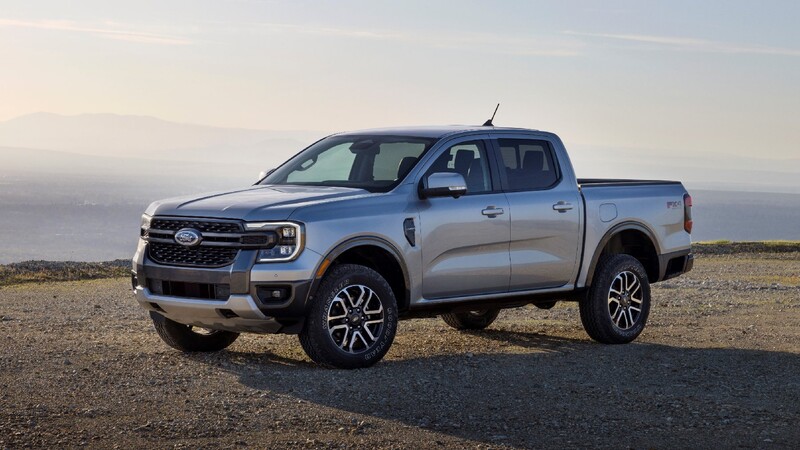
The Ranger, like its rivals, is a midsize truck that was previously a compact truck. Also like its rivals, it currently comes as a crew cab (with a short bed) only. But Ford does offer three different engines, depending on the trim.
Prices start at $33,350 for the XL trim with two-wheel drive; adding the optional four-wheel-drive system bumps the sticker price up to $36,850. This version of the Ranger comes standard with a turbocharged 2.3-liter four-cylinder engine, a 10-speed automatic, a six-speaker stereo, a digital main instrument panel and a 10-inch LCD touch screen.
The XLT ($35,875 for the 2WD version, $39,365 for one with 4WD) comes standard with the same drivetrain, but you can opt for a more powerful 2.7-liter V6 — if you first buy the 4WD version. This adds an additional $2,295 to the sticker. XLTs also come standard with a 120V household power point, LED bed lighting and a wireless charge pad.
The Lariat ($43,755 for one with 2WD; $47,255 with 4WD) is also eligible (4WD models) for the more powerful 2.7-liter engine and comes standard with a powered sliding rear window, 10-speaker premium B&O audio system, a larger (12-inch) secondary touch screen and synthetic leather seat covers, among other upgrades.
At the apex is the Raptor, a high-performance/off-road variant of the Ranger that comes, uniquely, with a 3.0-liter twin-turbo V6 and 405 horsepower, standard 4WD and a slew of off-road upgrades that includes locking front and rear differentials, 17-inch wheels with 33-inch all-terrain knobby tires, tow hooks, fender flares and a modified suspension that features a wider track, along with Fox off-road shocks.
This one stickers for $57,020.
What's New for 2026
The FX4 off-road package — which used to be limited to higher trims — is now available with the base trim. It bundles skid plates, an electrically locking rear axle, off-road shocks and other upgrades.
What's Good
— Standard 2.3-liter four is almost as powerful as the V8s in full-size trucks were 25 years ago.
— Even with the little four, this truck is rated to pull up to 7,500 pounds.
— Crew cab is much roomier than the much smaller regular/extended cabs that compact trucks had.
What's Not So Good
— Pushing $40,000 for the least-expensive 4WD-equipped version of the base XL trim. Rival trucks such as the Toyota Tacoma, Nissan Frontier and Chevy Colorado are similarly pricey — but all of them used to be much less so.
— Regular cab/extended cab not available.
— Short (5-foot) bed is the only available bed size.
Under the Hood
The Ranger's standard turbocharged 2.3-liter engine makes 270 horsepower and 310 foot-pounds of torque.
XLT trims are eligible for the optionally available 2.7-liter twin-turbo V6, which makes 315 horsepower and 400 foot-pounds of torque. This same engine is available in the much larger current F-150, so it transforms the smaller/lighter Ranger into a pickup with real pickup. It can get to 60 mph in 5.6 seconds, which — for some sense of just how quick that is — is quicker than a 2005 Mustang GT with a 4.6-liter V8.
On the downside — as regards the 2.7-liter V6 — it's a big step up in price to get it because you must first buy at least the XLT trim, and then you must buy the optional 4WD to be able to opt for the V6. This will push the price of the Ranger to about $42,000.
The Ranger Raptor comes with a larger, 3.0-liter V6 that touts an astounding 405 horsepower and 430 foot-pounds of torque.
All the Ranger's engines are paired with a 10-speed automatic.
On the Road
The new Ranger feels like the nearly full-size truck it is — at least by the dimensional standards that defined a full-size truck through the early 2000s, before full-size trucks got super-sized.
This has its pros and its cons
On the pro side, you feel as if you're driving a larger, more substantial — and much stronger — truck than the compact Ranger that Ford canceled back in 2011. The no-longer-available compact trucks had many virtues, but one of them wasn't that they were strong. Equipped with their standard, non-turbocharged four-cylinder engines that typically made around 150 horsepower, they were not going to get you to 60 mph in the mid-five-second range. Ten was more like it. And because they didn't come standard with a lot of power, they typically were rated to pull 3,500 pounds. Maybe as much as 5,000 pounds — if you bought one with its optional V6 (which was also not turbocharged and made less power than the current Ranger's standard four).
On the con side, this is a big truck — and feels like it is. It is just shy of 211 inches long, which is nearly as long as an early-2000s full-size truck. The main difference is that it's not as wide — and that is a saving grace on narrow country backroads. Today's super-sized full-size trucks are so wide that when two pass one another going opposite directions on a narrow country road, they sometimes smack mirrors.
That's not an issue with the Ranger.
Tight-space maneuvering, on the other hand, is. Or at least, it is more of an issue than it was back when the Ranger was still compact and was only 189.4 inches long. The 2026 Ranger is nearly 2 feet longer and, for that reason, isn't as easy to park in tight spots as the old Ranger and the other compact pickups were. The latter were also not as wide as the current model, and while that did make for a cozier cabin (less shoulder room), it also left more room in your garage. Those compact trucks only took up about as much floor space as a new Corolla or Civic — and had the additional virtue of coming standard with a 6-foot bed.
More about that — and related matters — now.
At the Curb
There are at least two interesting things about the Ranger. The first is that it is about as long — 210.9 inches — as a full-size/regular cab half-ton truck with a 6-foot bed from the early 2000s. A 2001 Ford F-150 XL regular cab — with the 6-foot bed — was 206.9 inches long. The 2001 F-150 was a smaller truck, in other words, than the current "midsize" Ranger is — except in terms of width. The '01 F-150 was wider — three could sit across (up front) in the regular cab, and even though the bed was short (for a half-ton truck), it was still wide enough that you could lay a four-by-eight sheet flat in the bed.
This brings up another interesting thing — more like a curious thing. The Ranger is only available in one configuration: crew cab with four full-size doors and a short (5-foot) bed. The fact that it is a crew cab is why the bed is so short.
The old Ranger — last available in 2011 — was a much smaller truck, but it came standard with a longer 6-foot bed, because it came standard with two rather than four doors. It was feasible to add a 6-foot bed to a regular or extended cab body — but adding a 6-foot bed to a crew cab would push the length to too long, and that's why the current Ranger comes only with a 5-foot short bed. Others in the class — such as the Chevy Colorado — are similarly crew cab/short bed only.
The Rest
It'd be interesting to see what would happen if Ford were to offer a new Ranger more like the old (compact) Ranger. Not necessarily that size — but that basic, at least to start. Instead of the powerful turbocharged four, a powerful-enough four without a turbo — paired with a standard manual transmission. Nix the digital dash and the big touch screen. Maybe even make manual roll-up windows standard — and AC optional. Get the base price down to around $25,000 rather than $33,000.
Ford might sell a bunch of them.
The Bottom Line
The Ranger is without doubt the most powerful, most capable and nicest Ranger Ford has ever made. The problem is, it's become as expensive as a decently equipped full-size truck used to be not all that long ago.
Eric's latest book, "Doomed: Good Cars Gone Wrong!" will be available soon. To find out more about Eric and read his past columns, please visit the Creators Syndicate webpage at www.creators.com.
View the Ford Ranger this week.







View Comments